Published on: February 24, 2026
5 min read
Agentic SDLC: GitLab and TCS deliver Intelligent Orchestration across the enterprise
Scale DevSecOps with AI agents that work alongside developers to automate workflows, enforce compliance, and accelerate delivery.
GitLab and TCS are announcing their partnership to help enterprises accelerate innovation velocity at scale. Enterprises need rapid, secure software delivery but often struggle with fragmented toolchains, inconsistent security controls, and manual compliance processes which slows software delivery. AI-generated code and AI-powered threats add new complexity. GitLab and TCS Center of Excellence (CoE) accelerators work together to reduce migration friction, codify guardrails, and industrialize DevSecOps adoption at scale. Together, they enable a path from standardization to Intelligent Orchestration with necessary auditable guardrails during development.
Supporting the future-ready enterprise
Customers want a DevSecOps platform built to last without forcing large-scale re-engineering every few years. GitLab's unified data model connects the entire software lifecycle into a single source of context, enabling enterprises to standardize pipelines, controls, and metrics at scale. GitLab's continuous innovation in AI-driven capabilities reinforces its long-term relevance as enterprises adopt agentic workflows to accelerate time to value.
GitLab and TCS synchronize multi-agent orchestration, dynamic planning, confidence-scored decisioning, and continuous learning cycles to automate coding, reviews, testing, security, and CI/CD workflows.
GitLab Duo Agent Platform provides Intelligent Orchestration across the software lifecycle through context-aware autonomous actions, multi-step reasoning, code modernization, security scanning, and flow automation, streamlining and accelerating software development. This aligns naturally with TCS’ structured agent hierarchy for IT Operations, enabling dynamic reasoning, planning, and domain agents to invoke GitLab Duo Platform’s specialized agents (e.g., Planner, Security Analyst, Code Review) through MCP-driven integrations and rich project context flows, governed by GitLab’s AI-native DevSecOps controls.
Scaling DevSecOps with platform engineering
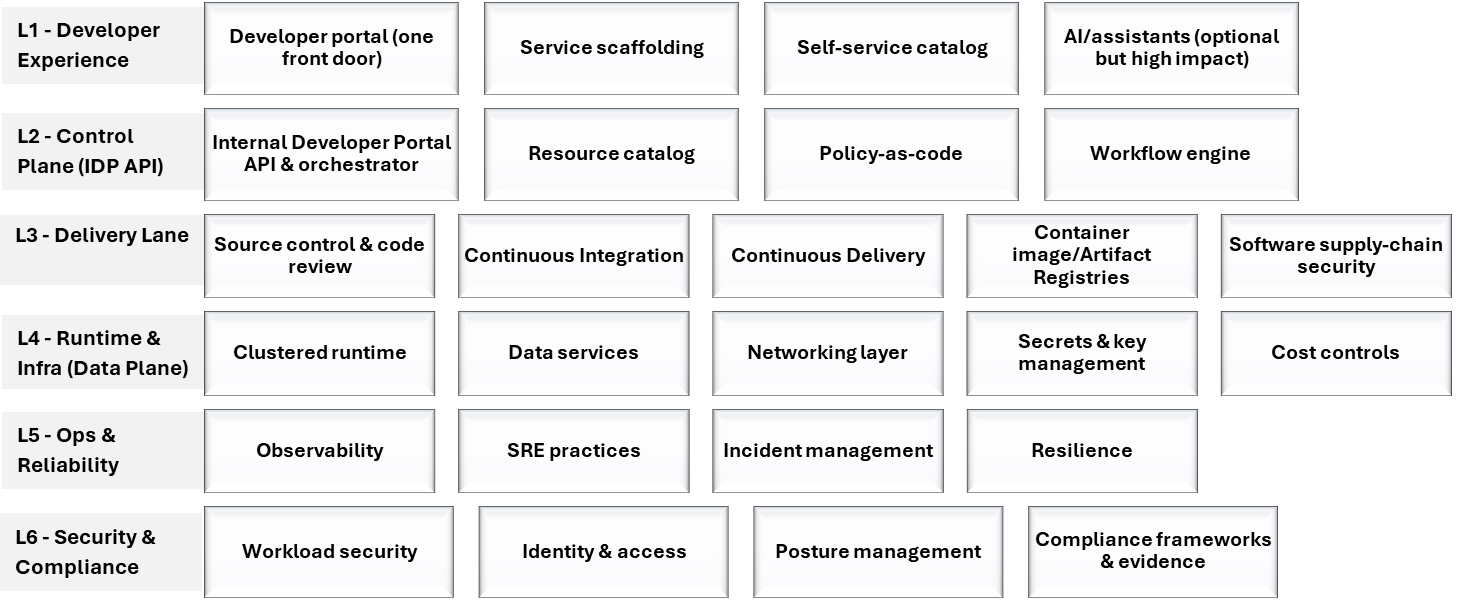
Platform engineering shifts the focus from managing individual pipelines and toolchains to building an Internal Developer Platform (IDP) that standardizes how software gets built, secured, tested, and deployed across the organization.
Enterprises scale by productizing the developer experience through platform engineering, operating IDPs with self-service golden paths. Security, compliance, and governance are embedded by default through policy-as-code, standardizing Day 2 operations. GitLab becomes the IDP control plane, and TCS industrializes the design and rolls out self service as a wrapper on the control plane to deliver a strong developer experience. As solution architects, TCS builds self-service paths while GitLab Duo Agent Platform adds agentic AI to automate development across the SDLC.
| Category | Details |
|---|---|
| Experience Layer (IDP) | • Developer self-service scaffolding • One-click environment/runners/scans • Standardized onboarding |
| Platform Control Plane (GitLab) | • Merge requests as control point • Integrated CI/CD • Security • Software bills of materials (SBOMs) • Approvals • Telemetry |
| Guardrails and Governance | • Policy-based governance • Compliance as code • Risk-tiered golden paths • Mandatory controls without manual gates |
| Infrastructure and Runtime | • Cloud landing zones • Kubernetes/VM runtimes • GitOps-driven desired-state enforcement |
| Golden Paths | • Ensure products are continuously improved and safely extensible • Eliminating pipeline drift while preserving autonomy |
| Day 2 Operations | • Automated rollback • Runtime SLOs tied to release policies • Vulnerability SLAs • Cost visibility • Operational excellence built into platform |
From DevSecOps to Intelligent Orchestration
A unified DevSecOps platform provides enterprises with a foundation, but as AI agents become active participants in the software lifecycle, the platform must do more than manage code and pipelines. It needs to orchestrate the work of humans and AI agents together, with full lifecycle context and guardrails built into the flow. That's the shift from DevSecOps to Intelligent Orchestration that GitLab Duo Agent Platform enables, improving the quality of software delivery over time.
GitLab Duo Agent Platform
GitLab Duo Agent Platform introduces AI agents into the software development lifecycle that work alongside developers as collaborators. Multiple AI agents handle tasks in parallel — from code generation and testing to CI/CD fixes — reducing bottlenecks and speeding up releases. Developers steer and guide these agents using defined rules, maintaining control while offloading repetitive work. This agent orchestration tackles complex workflows (such as auto-fixing broken pipelines) and frees teams to focus on higher value work.
AI agents work within GitLab's unified data model, creating merge requests, improving code, and supporting compliance, which boosts productivity and velocity. Because every agent action has full project context, is auditable, and is policy-aligned, enterprises can scale AI across thousands of engineers with confidence, maintaining security and regulatory compliance across all automated workflows. This reduces toil for application engineers, DevSecOps engineers, scrum masters, and product managers.
Understanding the reference architecture
GitLab + TCS: A powerful combination
GitLab provides an Intelligent Orchestration platform for DevSecOps where software teams and AI agents work together across the entire development lifecycle. TCS provides industrialized adoption engines, proven reference architectures, large-scale migration factories, enterprise-grade security baselines, enterprise AI capability, AI Trust & Risk management tools and frameworks, and a product mindset for platform operations.
What truly differentiates this combination is TCS' contextual knowledge gained from decades of working with customers across industries, geographies, and regulatory landscapes. This experience enables TCS to contextualize GitLab capabilities to address enterprise constraints like legacy estates, compliance requirements, operating models, and scale challenges — rather than implementing tooling in isolation. Together, GitLab and TCS enable fast, assured, enterprise-scale delivery across clouds with built-in compliance.
To learn more about GitLab + TCS, email [email protected].
More to explore
View all blog posts

We want to hear from you
Enjoyed reading this blog post or have questions or feedback? Share your thoughts by creating a new topic in the GitLab community forum.
Share your feedback